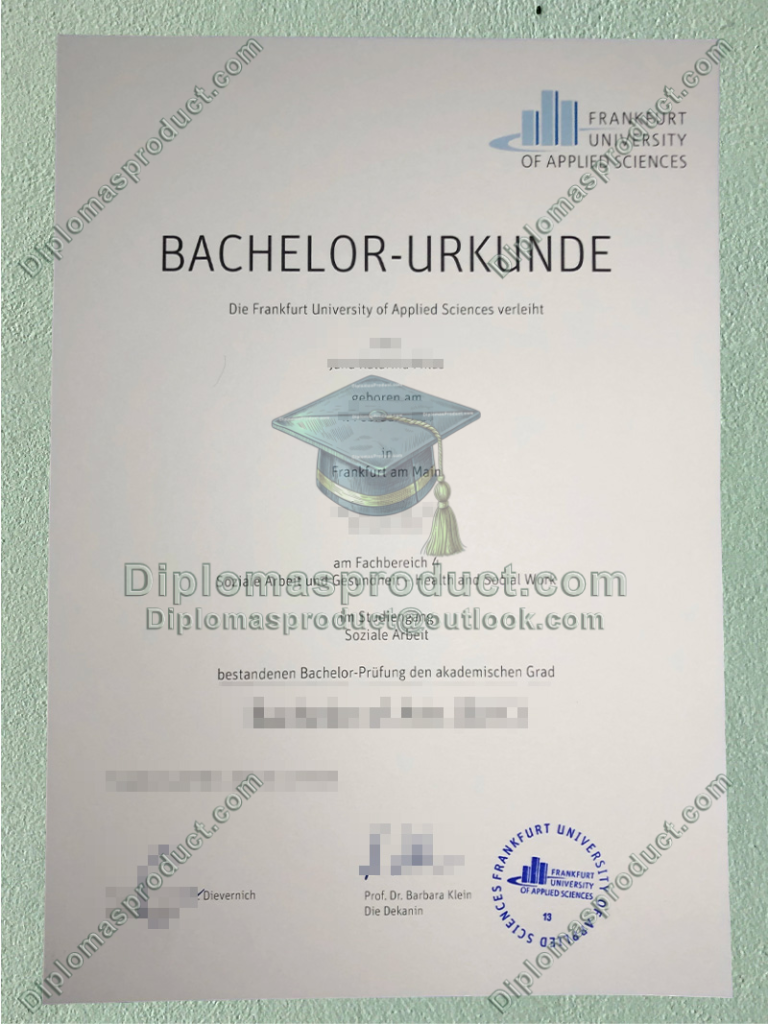
Frankfurt University of Applied Sciences is a public university of applied sciences in the German state of Hesse, officially established in 1971. Today, it has grown into one of the largest universities of applied sciences in the Rhine-Main region, with approximately 15,000 students, four faculties, and 72 undergraduate and graduate programs. Guided by its core principles of “practice-oriented, international, and innovation-driven,” it sets the standard for applied talent development in Germany across engineering, information technology, economics, and social work.
❖ History and Legacy: A Pioneer in Germany’s Applied Sciences Movement
✧ Founded in 1971: Frankfurt University of Applied Sciences was established in 1971, emerging as an early practitioner within Germany’s applied sciences movement. In October 1968, the Conference of Ministers of Education and Cultural Affairs of the Federal Republic of Germany adopted the “Agreement on the Harmonization of Higher Technical Colleges in the Federal Republic of Germany,” formally introducing the concept of higher technical colleges. In 1971, Frankfurt University of Applied Sciences emerged as a product of this reform, formed through the merger of several engineering schools and higher technical colleges. A Guide to Quickly Replacing a German Diploma
✧ From Engineering Schools to Universities of Applied Sciences: The institution’s origins trace back to Germany’s traditional engineering schools. Prior to 1968, these were not higher education institutions; admission required only a secondary school diploma, similar to vocational colleges [c:2]. Following the 1968 educational reforms, engineering schools were integrated into the higher education system, forming the foundational backbone of today’s universities of applied sciences [c:2].
✧ Half a Century of Development: Over its fifty-plus years, the university has consistently upheld a practice-oriented educational philosophy. It has evolved from its origins as an engineering and technology institution into a comprehensive university of applied sciences spanning engineering, information technology, economics, law, social work, health, and multiple other fields[c:1].
✧ Current Scale: Today, the university hosts approximately 15,000 students and 310 professors, offering 72 undergraduate and master’s programs. It ranks among the largest universities of applied sciences in the Rhine-Main region[c:9].
❖ Faculties and Programs: A Comprehensive Disciplinary Matrix Across Four Schools
✧ Four-Faculty Structure: Frankfurt University of Applied Sciences comprises four faculties, forming a complete applied discipline ecosystem spanning engineering to social health [c:4][c:9]:
▸ Faculty of Architecture, Civil Engineering, and Geoinformation: Offers programs in architectural design, urban planning, civil engineering, and geographic information systems, renowned for future city development and design [c:4]
▸ Faculty of Information and Engineering: Offers programs in mechanical engineering, electrical engineering, computer science, information technology, and product development[c:9]
▸ Faculty of Economics and Law: Provides courses in business economics, international business, economic law, and public administration[c:4]
▸ Faculty of Social Work and Health: Focuses on social services disciplines including social work, nursing management, and public health[c:4]
✧ Distinctive Programs: Product Development and Technology Design is the university’s signature dual-system program. Students sign training contracts with partner companies, combining theoretical study with practical industry experience[c:7]. Curriculum covers computer-aided development, design techniques, materials, and manufacturing processes, cultivating engineers capable of designing consumer products and technical systems[c:7].
✧ English-Taught Master’s Programs: The university offers English-taught master’s degrees in High-Integrity Systems, Information Technology, and Urban Development, open to international students [c:4]. Programs last 1.5-2 years, requiring applicants to provide proof of a bachelor’s degree and English proficiency certification [c:1].
✧ Key Research Areas: The university focuses on three cutting-edge fields—population change and diversity, digital and information communication technologies, and automotive and logistics engineering[c:9].
❖ International Collaboration & Exchange: A Cultural Melting Pot of Students from 121 Countries
✧ Highly Internationalized Campus: Students from 121 countries and regions study here, with approximately 2,100 international students (18% of the total student body), fostering a highly diverse cultural ecosystem [c:9]. Here, you’ll not only hear a multitude of languages but also experience the unique charm of cross-cultural exchange [c:6].
✧ Global Partner Network: The university maintains semester exchange programs with 60 institutions worldwide and collaborates with 261 partner universities[c:9]. Students may study one or more semesters at any of these 60 partner universities to broaden their international perspectives[c:6]. Tuition is typically waived at non-European partner universities, and students may apply for scholarships such as DAAD-PROMOS and Fulbright[c:8].
✧ Sino-German Collaboration: The university signed a cooperation agreement with Henan Normal University in 2022. Under the “Innovation and Talent Introduction” framework, it implements faculty and student exchange programs including joint research project applications, short-term academic visits, and cross-cultural education curriculum development[c:1].
✧ International Collaboration Outcomes: Third-party research funding reached €9.8 million in 2021, reflecting the university’s active engagement and competitiveness in international scientific collaboration[c:9].
✧ Member of Germany’s Silicon Valley IT Cluster: As part of the Rhine-Main-Neckar IT Cluster within Germany’s Silicon Valley—Europe’s most significant hub for IT and high-tech industries—the university possesses unparalleled industrial resources in information technology[c:4].
❖ Teaching Model and Signature Programs: Deep Integration of Dual System and Practice-Oriented Education
✧ Dual System Training Model: Undergraduate education implements a dual system training model, deeply embedding corporate practice components into the curriculum[c:1]. Typical teaching arrangements include:
▸ Completing foundational theoretical studies in the first two years
▸ Entering partner enterprises for professional internships in the third year
▸ Graduation projects must address real-world technical challenges faced by enterprises[c:1]
✧ Close Industry-Academic Collaboration: Students sign training contracts with partner enterprises upon enrollment, undertaking practical placements during academic breaks to directly apply classroom knowledge to real-world work[c:7]. This theory-practice integration equips graduates with solid practical experience and problem-solving skills while providing paid work opportunities[c:7].
✧ Project-Based Learning Throughout: Starting in their freshman year, students join interdisciplinary teams. Through project-based learning, experiments, and other methods, they acquire knowledge in real-world scenarios, cultivating independent thinking and problem-solving abilities.
✧ Academic Achievement Evaluation Criteria: Emphasizing practical application value, graduation theses must include field research data from no less than three months of on-site investigation[c:1].
✧ Graduate Employment Rate: The university has maintained top employment rates among German universities of applied sciences for five consecutive years, with 83% of engineering graduates securing formal employment within six months of graduation[c:1].